

The Marketplace for Intelligence
Why We’re leading ByteStrike’s pre-seed round

Lucrum Verus Capital is leading ByteStrike’s pre-seed round to build a regulated futures exchange for GPU compute.
Manufactured Intelligence
A world that wants to move faster needs more intelligence. Intelligence used to be locked within the skulls of the earth’s inhabitants. Now earth’s residents are aided by intelligence produced in data centers. Those data centers manufacture one of the core components for artificial intelligence (AI) through a combination of human expertise, raw materials, and sophisticated manufactured components. What these data centers produce specifically is something called “compute.”
Compute is the usable capacity of computer hardware and software systems to process data by executing instructions: performing arithmetic, processing logic, accessing memory, and controlling operations. In a data center, compute usually refers to the pooled processing power of central processing units (CPUs), graphics processing units (GPUs), memory, and supporting systems that can be allocated to tasks like running applications, serving websites, training AI models, querying databases, or rendering video.
Compute is the practical ability to turn electricity, hardware, cooling, networking, storage, and orchestration software into useful digital work.
An AI Bottleneck
As AI becomes increasingly ubiquitous, compute becomes increasingly important. Every AI feature depends on massive amounts of processing work happening behind the scenes. When a user asks a chatbot a question, generates an image, summarizes a document, or gets a personalized recommendation, the AI system must run complex mathematical operations across large neural networks. These models often contain billions of parameters, and each request requires processors, especially GPUs, to move data through those models quickly enough to produce a useful response. Better compute makes AI services faster, more capable, more reliable, and able to support richer experiences.
Demand is incredibly high for compute because consumer AI usage has scaled from occasional experimentation to everyday utility. Millions of people now expect AI tools to be available continuously, respond in seconds, and handle text, images, audio, video, and software tasks at the same time. At the same time, companies are competing to train larger models, serve more users, reduce latency, improve accuracy, and lower cost per request. That creates pressure for more data center GPUs, more power, more cooling, better networking, and more efficient systems.
In practical terms, compute hours (the standard metric used to quantify compute capacity) has become one of the main bottlenecks in consumer AI: the amount of available compute helps determine how many users can be served, how advanced the models can be, how fast responses arrive, and how economically AI products can scale.
A Global Commodity
Compute has become a valuable resource with many global producers and consumers who buy and sell based on organic demand: Compute is a Global Commodity.
And like other critical commodities - oil, wheat, LNV, gold, coffee - compute needs a robust and organized market serving producers, users, speculators to enable accurate price discovery, continuous selling and acquisition, and hedging.
A small but fierce industry is emerging to solve this problem.
Building a Compute Market
There are two key problems to solve in order to deliver an adequate market for compute:
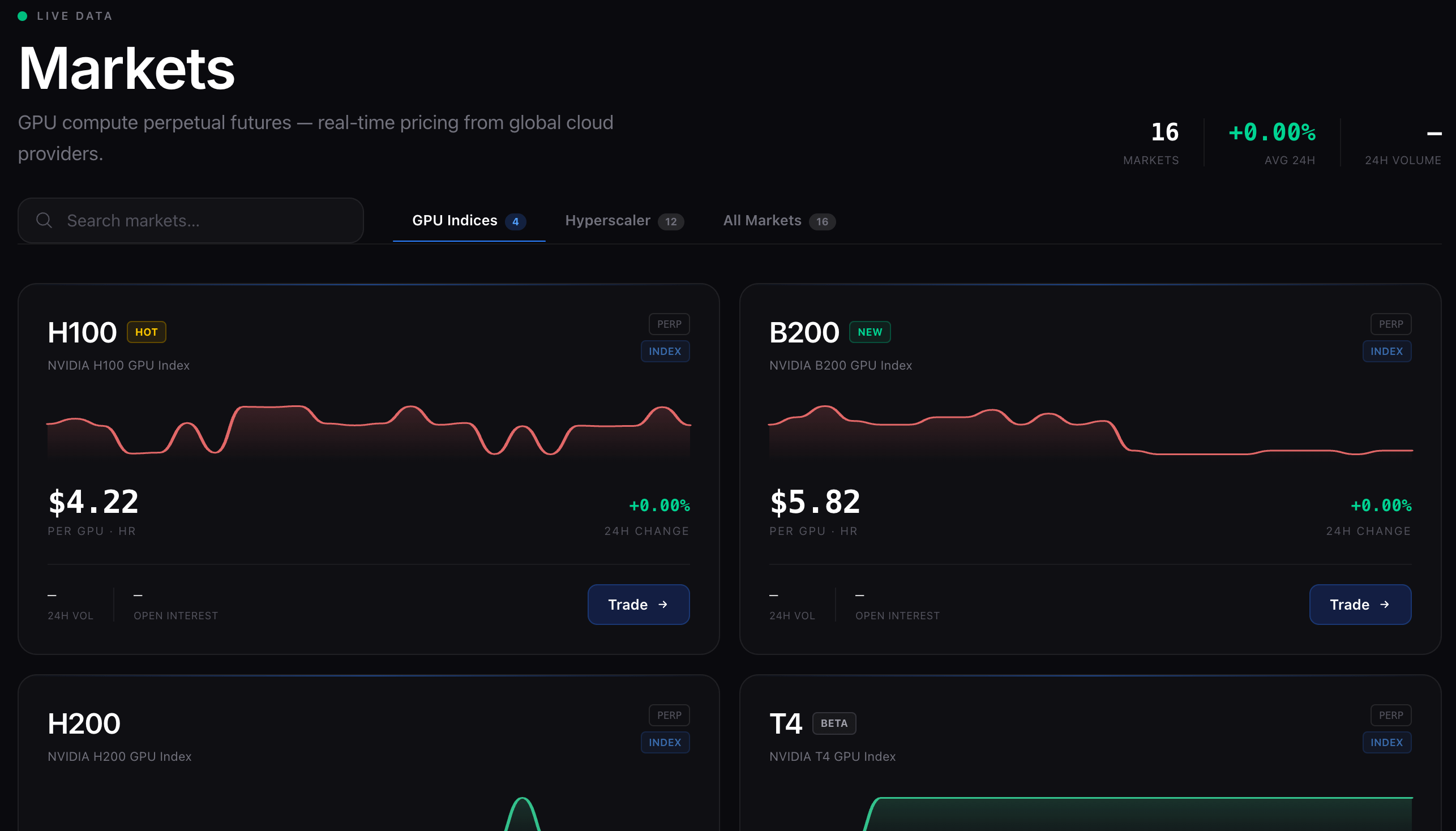
Creating accurate indexes to track, and make available, the market price for compute hours produced by distinct GPUs like the Nvidia H100, A100, B200, and T4.
Matching the index with a platform powerful enough to enable active trading of said compute hours.
Most entrants to this small space are solving the first problem. Establishing a single, reliable, and definitive price requires several complicated objectives including identifying and classifying compute providers (Hyperscalers and Neoclouds), accurately collecting and validating standardized market data, understanding the unique characteristics of different GPUs, creating a weighting model to reflect the market structure, using that to calculate a price, and ultimately publishing that data in a timely manner.
Creating these indexes is a task worthy of single-minded focus (demonstrated by the startups funded in this space). But it is ultimately an incomplete product that must then be partnered with the creation of another entity, a powerful trading platform.
ByteStrike: the Complete Solution
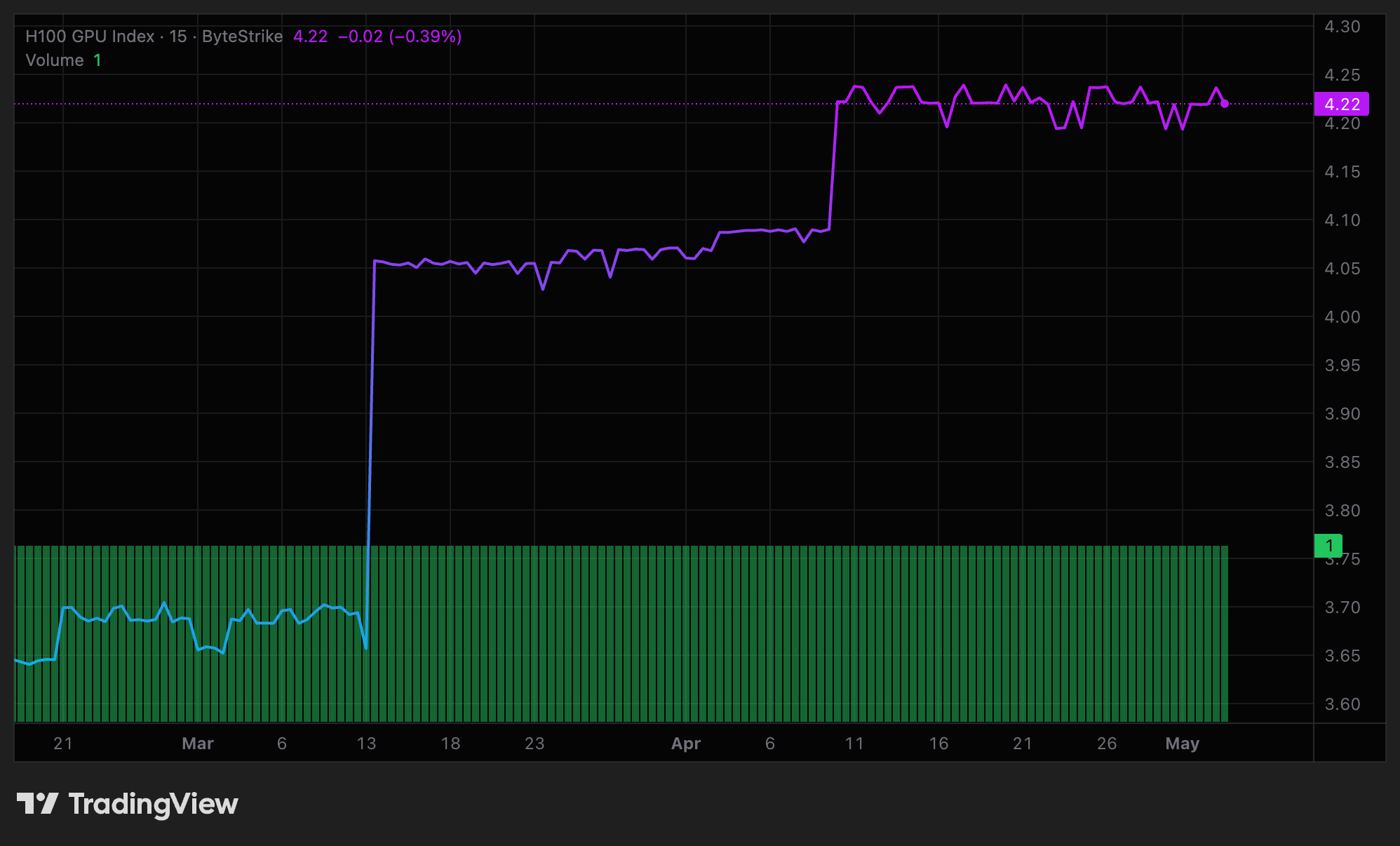
ByteStrike, Lucrum Verus Capital’s newest portfolio company, is going after both components, and they’re doing it on a blockchain.
Leveraging blockchain based technology is not the only way to accomplish this task, but we believe it is the optimal way. Non-custodial crypto protocols enable unique transparency, verifiability, and access that we think should be standard for financial and data infrastructure from here on out.
Specifically, ByteStrike is using a crypto-native financial contract called a perpetual future to enable trading on their Arbitrum based protocol. Perpetuals enable powerful directional (long or short) positioning for any asset that has a clear and reliable price feed, and they enable the simple deployment of leverage allowing users to trade with a limited amount of collateral.
Regulation is the Core Unlock
Also unique to ByteStrike’s strategy is its focus on building a regulated and licensed trading venue to enable participation by a wide variety of market actors, including crypto-native firms and traditional financial institutions.
From the LVC perspective, this is the core unlock for this nascent market.
The technology is ready. What is changing now is the regulatory and market-structure environment around crypto-native financial infrastructure. Jurisdictions such as Bermuda, through forward-looking digital asset licensing regimes like DABA, are creating pathways for companies to build compliant trading venues around new categories of digital and financial activity. For ByteStrike, this is not a cosmetic regulatory wrapper. It is central to whether the business can launch credibly, attract serious participants, and become more than a speculative retail product.
This is exactly the kind of opportunity LVC exists to underwrite:
regulatory unlock → infrastructure viability → adoption and distribution → value capture.
If ByteStrike can secure the appropriate regulatory footing and launch without major product or security issues, the company moves from being an unlicensed concept exchange to a regulated compute-market venue. That matters. It narrows the competitive set, makes institutional participation more plausible over time, and creates the possibility that the venue itself becomes a scarce piece of market infrastructure.
A licensed exchange structure can have value beyond near-term revenue if larger firms eventually want access to regulated crypto-native market infrastructure. In this sense, ByteStrike is not only racing to build a compute market. It is also racing to secure a position inside the regulatory architecture of what that market may become.
Why LVC is Backing Gabe, Quinn and the ByteStrike Team
LVC is a regulation-first, thesis-driven crypto fund. We do not invest in crypto because every new market should be put on-chain. We invest where regulatory change, market-structure evolution, and infrastructure maturation make a specific company, asset, or protocol newly viable, newly scalable, or newly valuable.
We met founder and CEO Gabe Jaffe through introduction from a close friend nearly six months ago with no initial consideration of an investment opportunity, but with a shared interest in great technology leveraged to solve important problems. That relationship developed overtime into a partnership that we’re proud to support.
Gabe and his cofounder Quinn Domina are young and hungry builders with a combination of experience in entrepreneurship, finance, marketing, and crypto that make them ideal to lead the development of ByteStrike as it moves toward mainnet launch.
We are proud to lead ByteStrike’s pre-seed round and support Gabe, Quinn, and the ByteStrike team as they build the marketplace for intelligence.
For now, we recommend you try the platform on testnet at byte-strike.com