

Polymorphic Rails
How a shared crypto substrate powers parallel financial futures

TLDR: Crypto is evolving into a polymorphic financial substrate: the same decentralized rails—with adoption driven by supportive U.S. policy and explosive infrastructure growth—will simultaneously harden into core global financial infrastructure, sustain an increasingly gamified, speculative economy, and enable more automated transactions; bringing orders of magnitude more value onchain.
In the fall of 2008—as the globe’s financial system spiraled out of control, driven by irresponsible behavior from the masters of the universe—a pseudonymous figure called Satoshi Nakamoto quietly shared a document describing a new kind of money. It was called Bitcoin. Bitcoin was meant to be the antidote to the lack of individual control that the traditional financial system, managed by too-big-to-fail institutions and overseen by governments, offered to the everyday person.
The Original Vision: Peer-to-Peer Transaction
A simple PDF describing Bitcoin, the “whitepaper,” as it came to be called, clearly and elegantly laid out a vision for a “Peer-to-Peer Electronic Cash System,” a system “based on cryptographic proof instead of trust, allowing any two willing parties to transact directly with each other without the need for a trusted third party.”1
The whitepaper created the vision for a “decentralized” future, one where traditional intermediaries would no longer be required, where any individual could engage as a first-order participant within a financial system, and where value and power were naturally pushed to the edges rather than pulled toward the center. Bitcoin presented several innovations, one of which was a fundamental systems architecture to track transactions over time called a blockchain.
A blockchain is a mathematically linked string of chronologically ordered bundles of transactions. Transparent and immutable, the blockchain maintains the record of activity occurring across a network, making it robust against manipulation and uniquely auditable. And across the blockchain, transactions were denominated in a currency native to the network, a digital token accounting for ownership. These tokens represented a powerful new paradigm: one of digital, verifiable ownership and scarcity.
Digital scarcity created the potential for increasing value in purely digital bearer assets; value accrues where that scarcity intersects with real demand for utility, narrative, or rights.
At this point in the story, the crucial point is not the technical detail, but the shift in architecture: Bitcoin demonstrated that we could have a credibly neutral, globally accessible ledger that no single state or corporation controlled. Everything that follows—smart contracts, stablecoins, DeFi, NFTs—are elaborations of that basic breakthrough in verifiable digital ownership.
From Experiment to Ecosystem: Years of Evolution
In the intervening years since the birth of Bitcoin, the crypto ecosystem—so-called because of the technology’s reliance on cryptography to verify transactions—has expanded to include a suite of financial primitives far beyond the simplicity of direct transaction. And participation has grown far beyond the small online networks of message boards filled with radical nerds Satoshi first shared the Bitcoin idea with. In 2025, crypto assets surpassed a combined market capitalization of over $4 trillion2, and more than 560 million people worldwide now hold or use crypto in some form.
From the birth of Bitcoin and the blockchain in 2008, to the advent of the Ethereum Virtual Machine, the general-purpose smart contract in 2013, token standardization in 2015, the integration of zero-knowledge proofs in 2016, to the advent of stablecoins in 2016, the creation of decentralized oracles, the Ethereum transition to a proof-of-stake consensus mechanism, and the dawn of the automated market maker on Uniswap and the explosion of DeFi summer and beyond, crypto has continued to evolve at a breakneck pace.
These innovations have represented the adaptation of traditional financial primitives for an onchain context, and ultimately the creation of new capabilities uniquely enabled by decentralized blockchains, specifically related to accessibility, transparency, and the efficiency derived from not having to route transactions through rent-seeking or regulation-mandated intermediaries.
These innovations have generally remained strictly within the crypto sphere for the better part of the last two decades, creating a relatively isolated, though vibrant, ecosystem. This digital reality developed its own tribal customs, business practices, visionary leaders, villains, winners and losers, oscillating between major FUD (Fear, Uncertainty, Doubt) and WAGMI (We’re all Gonna Make It) jubilation with metanarrative-driven boom and bust cycles of the market.
Crypto quietly built out an almost complete shadow financial system including exchanges, collateral, credit, derivatives, market-making, risk management and more, but did so largely in parallel to, and wholly separate from, the traditional system, with its own esoteric language and culture. For most of its first decade and a half, this has remained a high-volatility sandbox: dynamic and compelling in terms of ideas, but not yet systemically important in terms of assets and flows.
Onchain Convergence: As Crypto Meets TradFi
What we’re seeing glimpses of now is the convergence of two worlds: of the isolated, relatively small, and dynamic crypto market, and of the ubiquitous, absolutely enormous, and relatively staid traditional finance (TradFi) world. As the resilience of decentralized protocols continues to be demonstrated, more and more systemically important assets, transactions, and markets will come onchain (decentralized finance protocols surpassed the $160 billion mark in total value locked (TVL) in 2025)3. As the efficiencies of the onchain world become more apparent, TradFi will increasingly integrate the crypto technology into its work streams.
This shift (part of what I call the Polymorphic Rails Thesis) is impending and set to move rapidly over the next several years, bringing trillions of dollars of value onchain and bringing the innovations of crypto to billions of people within the next decade. It is not a march toward a single tidy end state, but toward a multifaceted reality in which sober institutional finance and highly gamified speculative activity coexist on the same rails.
Crucially, this is not just “TradFi using some crypto tech.” It is the same chains, the same liquidity pools, the same messaging standards and wallets increasingly serving multiple disparate needs and communities. Tokenized treasuries, cross-border payroll, and dog-coin perpetual futures are all starting to share blockspace, collateral, and routing infrastructure. That shared substrate is what makes the convergence so powerful.
Defining a Polymorphic Future: One Set of Rails, Many Economies
This onchain convergence is not a straight line toward a single, uniform future. The same infrastructure that is integrating with traditional finance is also accelerating a parallel, more chaotic trajectory: an increasingly gamified, speculation-driven economy that treats markets as both coordination mechanism and entertainment.
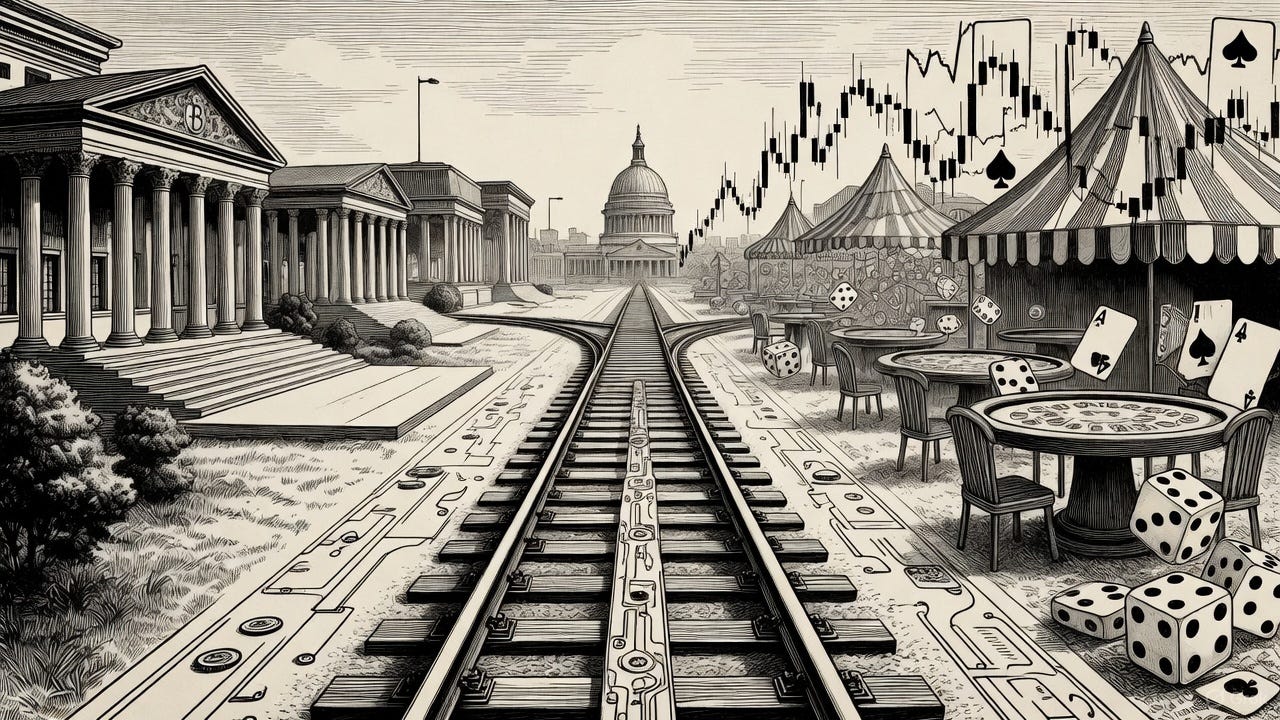
By “Polymorphic Rails,” I mean a single, general-purpose settlement substrate—the base layers, rollups, and shared sequencing infrastructure of crypto—that simultaneously expresses multiple distinct economic “modes.” At minimum, three modes are emerging: (1) institutional and sovereign finance using crypto rails for settlement and collateral; (2) retail speculation and entertainment, where markets blur into games and social experiences; and (3) machine-native and programmatic finance, where software agents, APIs, and devices transact directly with one another. These modes look, feel, and are regulated very differently, but they increasingly ride on the same underlying rails.
Outside of crypto, this phenomenon is already visible in the rapid rise of online gambling and sports betting, where financial risk and entertainment have collapsed into a single experience. The global online gambling market generated about $78.7 billion in revenue in 2024 and is projected to reach roughly $153.6 billion by 2030, implying a compound annual growth rate of around 11.9%.4 Crypto makes this pattern programmable and global. Perpetual futures, onchain prediction markets, and hyper-financialized meme assets are not sideshows; they are early expressions of a broader shift in how people interact with risk, narrative, and money online. On major venues, crypto derivatives, particularly perpetual futures, now see average daily trading volumes exceeding $100 billion and monthly volumes over $3 trillion, with derivatives markets running at roughly four times the size of spot trading by volume5.
This is the polymorphic nature of crypto rails. A layer 1 blockchain does not care whether a transaction settles a tokenized Treasury bill, a cross-border payroll batch, or a highly leveraged perpetual on dog-themed meme coins. A decentralized exchange does not distinguish between a blue-chip governance token, a stablecoin pair, and a speculative microcap. The same primitives—blockspace, liquidity, composable smart contracts—can instantiate multiple versions of the future at once: conservative, regulated financial infrastructure and permissionless, gamified markets that look more like digital casinos or massively multiplayer games.
Rather than viewing speculation and “seriousness” as opposing forces, it is more appropriate to understand them as coexisting modes on shared infrastructure. Speculation bootstraps liquidity, attracts users, and stress-tests systems. Institutional use cases demand reliability, compliance, and scale. Both benefit from the same improvements in throughput, security, identity, and settlement. The rails are singular; the expressions are plural. The Polymorphic Rails Thesis is simply the recognition that this shared substrate will continue to express multiple economic “faces” at once.
The polymorphic nature of these rails is also a double-edged sword. The same features that make them ideal for efficient settlement; global access, composability, 24/7 markets, make them ideal for over-leveraged gambling, ponzi-like reflexivity, and socially corrosive forms of financialization. Periodic blowups in the “casino layer” will invite political backlash and regulatory tightening. As investors, we have to assume that parts of the speculative surface will be periodically curtailed, even as the underlying rails continue to grow more deeply embedded in legitimate commerce and finance.
A Note on Scale: How Does Crypto Scale by an Order of Magnitude?
In late 2025 the total crypto market cap is just over $3.1 trillion, summing the value of all digital assets, denominated in USD. How do we bring “orders of magnitude more value onchain”? Not by a single monolithic asset, but by many categories of value gradually migrating their representation and settlement to crypto rails. A rough decomposition might look like this:
– Tokenized sovereign and high-grade corporate debt. Global bond markets exceed $130 trillion in size. If even 10–15% of that outstanding value is tokenized or routinely settled on crypto rails over the next decade, that alone contributes on the order of $15–20 trillion in onchain representations and flows.
– Stablecoin balances and payments. If dollar-linked stablecoins grow into a multi-trillion-dollar global float, and their annual payment volume reaches tens of trillions—displacing meaningful chunks of card networks, correspondent banking, and remittances—then both their circulating supply and a non-trivial fraction of global payments volume will be mediated by crypto rails.
– Derivatives and structured products. Crypto-native derivatives (perpetual futures, options, structured vaults) can easily reach multi-trillion-dollar notional volumes, and traditional rates, FX, and commodities derivatives are natural candidates to migrate to programmable settlement over time. Notional outstanding in global derivatives markets runs into the hundreds of trillions; a small percentage moving onchain translates into very large numbers.
– Tokenized real-world assets and private markets. Real estate, private credit, revenue-sharing agreements, and fund interests are beginning to be represented as tokens. These may never rival sovereign debt in scale, but cumulatively they can represent multiple trillions of value whose lifecycle—issuance, trading, collateralization—takes place onchain.
When you add these categories together—recognizing that some numbers refer to stocks (outstanding balances) and some to flows (annual or cumulative settlement)—you can plausibly arrive at a world where $100 trillion-plus of economic value is routinely touching crypto rails. The exact number is less important than the direction: from today’s niche to tomorrow’s default settlement fabric. The Polymorphic Rails thesis is not a bet that a particular asset hits a round-number market cap, but that crypto rails become the coordination layer through which a meaningful slice of global value and volume is routed by default.
Two Evolutionary Drivers
As this onchain evolution proceeds, an incredible amount of value will be created and propelled by two key drivers: Policy change and Infrastructure build. The previous era of crypto was defined by disruption of existing institutions; the Polymorphic Rails era will be defined by selective integration with, and the augmentation of, those systems. Decentralization will remain crucial at the protocol and settlement layers, while distribution, compliance, and user experience will increasingly leverage regulated entities and sectors.
We do not assume a straight-line, uniformly friendly policy trajectory. Instead, we anticipate a probabilistic, path-dependent process. The modal outcome we underwrite is one in which major jurisdictions gradually converge on clearer rules that recognize crypto’s role in payments, market infrastructure, and capital formation—while constraining certain speculative and privacy-preserving use cases. But we also consider less friendly and more chaotic paths: extended regulatory muddle, episodic crackdowns, or jurisdictional fragmentation. My thesis is that the rails themselves will survive these policy cycles, with value accruing to the assets and companies that are robust across a range of regulatory regimes.
The Crypto Capital of the World
For years, a key question hanging over crypto was whether Washington would ultimately embrace or reject the digital asset revolution. The absence of clear rules created hesitation for entrepreneurs and investors, while the threat of punitive enforcement actions cast a shadow over the industry’s future. Today, due to dramatic change in national leadership toward digital assets, that uncertainty is giving way to a very different future. The President has articulated a vision in which the United States takes its rightful place as “The Crypto Capital of the World,” a hub where financial innovation can flourish on decentralized rails. This is not simply a rhetorical stance but a guiding framework for policy, with Congress and regulators tasked to bring it to reality.
The Securities and Exchange Commission, under the leadership of Chairman Paul Atkins, is pursuing a constructive approach, seeking to enable an increasing number of crypto companies to compete on a clear regulatory playing field under the banner of Project Crypto. The Commodity Futures Trading Commission has similarly aligned its oversight of derivatives and trading markets with this new orientation and launched its own Crypto Sprint initiative. These shifts mark a turning point: rather than fighting crypto, U.S. institutions are beginning to integrate it into the architecture of the financial system.
The crypto industry is hard at work in Washington, advocating to US leadership that owning the crypto stack is as strategically important as owning the internet stack was in the 1990s. Progress has been, and will continue to be, uneven. Courts, Congress, and agencies will move at different speeds, and other regions—Europe, the Gulf, East Asia, Latin America, and Africa—will sometimes leapfrog the U.S. in specific niches like payments, consumer apps, or tokenized market infrastructure. For LVC, this means we view favorable U.S. policy as a powerful accelerant, but not a single point of failure: usage, innovation, and adoption can and will grow along multiple geographic vectors, even if Washington drags its feet or oscillates.
In the base case we underwrite, the U.S. eventually lands on a moderately supportive posture: stablecoins and core market infrastructure receive relatively clear rules, while some privacy-preserving or purely speculative use cases remain contested. Our job as investors is not to assume the rosiest scenario, but to own antifragile assets and businesses that get structurally stronger even if policy progress is slow, uneven, or led by other regions first.
Building the Rails: Infrastructure’s Explosive Growth
The second driver is the rapid build-out of crypto’s underlying infrastructure, particularly the explosive growth of stablecoins. Together, these dynamics are transforming crypto from an arena of speculation into an engine of adoption and enduring economic centrality.
Centralized exchanges such as Coinbase and Kraken have expanded far beyond their origins in spot trading. They now offer derivatives, yield products, custody solutions, and access to stablecoins. Other large financial players like Robinhood have joined in offering a rapidly increasing number of digital assets to retail and institutional customers. In doing so, they are positioning themselves as financial “super apps,” venues where individuals can manage an entire suite of services with crypto at the core. In October of 2025, combined spot and derivative volume on centralized exchanges exceeded $10 trillion6.
Decentralized exchanges like Uniswap and Hyperliquid have pioneered new models for market participation and capital formation. By enabling anyone to create and leverage liquid markets without permission, these platforms open the door to entirely new categories of economic activity. The significance of this cannot be overstated: decentralized exchanges are not just technological novelties, but structural innovations in how markets themselves can emerge and evolve. Alongside them, projects like pump.fun are lowering the barriers to token creation, while interoperability protocols such as Chainlink and LayerZero are weaving disparate blockchains into a cohesive, multichain ecosystem. All of these developments expand the reach and utility of crypto far beyond its early niches.
What unites this infrastructure is that it does not “care” which economic mode it is serving at any given moment. The same wallets, bridges, and routing layers can just as easily move tokenized U.S. treasuries between institutional desks as they can route leveraged meme-coin trades for retail users. That neutrality is what makes the rails polymorphic. It also means that infrastructure positioned at the right choke points—where many different modes and user types intersect—can capture outsized value as volumes and dependencies grow.
Stablecoins: The Monetary Engine of Polymorphic Rails
Among the many infrastructure categories emerging, one stands above the rest in terms of contemporary relevance: stablecoins. In September 2025, the total stablecoin market capitalization reached $300 billion, a 75% increase from a year earlier. Some estimates see the market exceeding $2 trillion by 2028. While I argue that the broad category of “trading” is the first killer app of crypto, stablecoins represent its most practical and widely adopted application. By anchoring the value of digital tokens to the U.S. dollar, stablecoins provide the stability of a familiar asset while harnessing the programmability, speed, and global accessibility of blockchain networks. For people around the world, they are becoming the first on-chain entry point into dollar-denominated store of value, payments, and financial services. In 2024 alone, stablecoins processed about $30 trillion in on-chain transaction volume (surpassing the annual payment flows of major card networks) with some analyses putting the figure as high as $46 trillion when broader fund flows are included, and stablecoins now account for roughly 30% of all on-chain crypto transaction volume7.
Stablecoins are also where regulatory clarity has been most transformative. The passage of the Guiding and Establishing National Innovation in US Stablecoins (GENIUS) Act in July 2025 provided a legal stamp of approval that has accelerated adoption at both institutional and retail levels. This shift has unleashed a wave of investment and competition. Circle has launched its own blockchain, Arc, specifically to scale stablecoin accessibility. Tempo, a project led by Paradigm and Stripe, is developing similar infrastructure aimed at making stablecoin usage seamless for consumers. Traditional financial institutions are joining the race as well, seeking to issue and distribute their own stablecoins in order to capture a share of this rapidly expanding market and reap its benefits.
The implications are profound. Stablecoins are no longer just another crypto product. They are becoming a foundational layer of the global financial system, one that extends dollar access to billions of people while enabling programmable money on a scale never before possible. As adoption accelerates, the stablecoin sector is likely to become one of the most important—and potentially lucrative—areas of investment over the coming decade.
Seen through the Polymorphic Rails lens, stablecoins are the shared monetary engine across all three modes described here. For institutional finance, they function as high-quality settlement assets and collateral for tokenized securities, FX, and credit. For the speculative and entertainment layer, they are the table stakes—the chips in the casino, the unit of account for perps, options, and memecoins. For machine-native finance, they are API-addressable dollars that software agents, protocols, and devices can hold and move without human intervention. This breadth of use is why we expect stablecoins and their surrounding infrastructure to sit at the very center of onchain value accrual.
The Polymorphic Rails thesis suggests the non-consensus view is that the largest long-run winners are likely to be distribution hubs that abstract away chains and tokens, not yet-another-base-layer. As the ecosystem matures, most users and enterprises will not choose “Ethereum vs. Solana vs. L2 X” any more than they chose “TCP/IP vs. anything else” today; they will choose the wallet, exchange, or embedded application that solves their problem with the least friction and the most trust. Chains and sequencers compete to be reliable, cheap, and secure—critical, but increasingly commoditized attributes. The entities that own intent, identity, and routing across multiple rails are the ones that can accumulate more usage and value over time.
In a polymorphic world, rails are interchangeable, but demand is scarce. Order flow, brand, and UX are the real choke points. We expect a handful of distribution hubs—wallets, fintech frontends, vertical “super apps,” and embedded rails inside non-crypto products—to sit atop many chains and tokens, dynamically allocating liquidity underneath. That is where we anticipate some of the most durable equity-like value to accrue, even if much of the infra layer continues to fragment, iterate, and reprice over time.
From Speculation to Permanence
This progress has significant implications for investors. The Polymorphic Rails thesis reframes the investment case for crypto in fundamental ways. It is no longer solely about speculating on short-term price cycles or chasing volatile trends, even though that speculative layer will likely remain a permanent, visible part of the landscape. Instead, it is about recognizing that crypto is embedding itself into the global financial system, and positioning accordingly.
The opportunities are wide-ranging and span the maturity spectrum. Publicly listed companies are building durable brands around digital assets. Stablecoin issuers and platforms are capturing global demand for programmable dollars. Crypto-native infrastructure protocols are enabling interoperability and liquidity. The digital assets themselves, supported by cutting-edge innovation and mainstream adoption, continue to represent an expanding universe of value creation. As crypto matures into core financial infrastructure, the speculative layer that once defined the entire space will persist as one of several modes of participation—sitting atop the same substrate that powers payments, settlement, and institutional capital flows. More startups are building within the crypto ecosystem and striving for longevity, without looking to create a token for quick liquidity. And other companies will look to go “public” directly on crypto rails, issuing tokens instead of stock, making good on the promise of the much-maligned “ICO boom” (Initial Coin Offering) of 2017.
There are, of course, real risks and failure modes. Regulatory shocks can reroute flows overnight. Poorly designed protocols can become systemic and then implode. Governance capture can siphon value away from token holders. Entire categories of speculative activity can be ring-fenced or pushed offshore. Our view is not that these risks vanish, but that they are features of an ongoing structural transition, not signs that the transition will reverse. The rails that prove useful to governments, institutions, and everyday users will persist and harden, even as parts of the casino layer are periodically demolished and rebuilt.
Investing on Polymorphic Rails
The Polymorphic Rails thesis is not merely descriptive; it is a filter for allocating risk as this vision of the future develops focusing on distinct categories of assets, protocols, and companies:
Settlement and sequencing layers. Exposure to the base layers, rollups, and shared sequencing infrastructure that form the core settlement fabric for multiple economic modes is critical. These are the chains and coordination layers where tokenized treasuries, consumer payments, and perpetual futures all ultimately converge. Our bias is toward systems with credible neutrality, sustainable economics, and deep developer traction. These are the substrates on which entire parallel economies will be built.
Monetary and collateral engines. The assets and businesses that provide the dollars and high-quality collateral that power onchain activity. This includes leading stablecoin issuers and networks, robust liquid-staking systems, and collateral protocols that are likely to be recognized by both market participants and, over time, regulators. These engines sit at the intersection of institutional and speculative flows, earning fees and spread while becoming increasingly embedded in how value moves onchain.
Aggregation and distribution hubs. Finally the wallets, exchanges, and embedded rails inside non-crypto applications where user intent originates and is routed. These are the interfaces that abstract away protocol complexity and translate raw blockspace into actual user experiences: investing, saving, remitting, gaming. In a polymorphic world, the entities that control order flow, identity, and UX across multiple modes of finance can accumulate durable moats—even when the underlying protocols remain permissionless and open.
Investing into this diverse future is best executed via a barbelled strategy across liquid and illiquid exposure: core, longer-duration positions in the rails and engines expected to be structurally important across regimes, complemented by more tactical positions that take advantage of cyclical dislocations in the speculative layer. It’s preffered to own positions in a smaller number of high-conviction choke points, where multiple modes and user types intersect, than a broad index of everything “crypto.”
Projects that are pure casinos with no meaningful spillover into the broader ecosystem, platforms whose economics depend entirely on regulatory blind spots, and governance structures that enable insiders to extract value at the expense of future users are all at odds with the antifragile nature of true polymorphic assets. Trading narratives opportunistically is at the heart of the degen mindset, but inferior to building core positions where value accrues because the rails are polymorphic, not despite it over the long-term. The protocols or companies that become critical dependencies for multiple types of users and use cases, across jurisdictions and cycles, will be the winners as crypto matures.
In practice, this drives diligence around a few recurring questions: Does an asset sit at a true choke point in the flow of collateral, information, or settlement? Does it benefit from both institutional adoption and speculative activity, or is it over-indexed to one? How does it fare under different regulatory and macro scenarios? And what does the world look like if this becomes part of the default financial stack in ten years? If those questions can be answered with conviction, the Polymorphic Rails lens has done its job.
A Structural Evolution
The Polymorphic Rails thesis describes more than a market cycle. It is a structural evolution, one that will define the trajectory of finance and commerce for decades to come. What began as a niche experiment reacting to the excesses of the global financial system is now becoming core infrastructure. With supportive policy from the United States, expanding adoption of stablecoins, and the rapid maturation of exchanges, protocols, and applications, crypto is firmly on the path from speculation to permanence, even as speculation itself hardens into a durable, gamified layer atop this new financial substrate.
The question is no longer whether crypto matters. That has been answered decisively. The real question is how much value will accrue to those who recognize the polymorphic nature of crypto, understand its multifaceted nature, and find the infrastructure and assets where value will accrue.
Rashan@lucrumverus.com
https://bitcoin.org/bitcoin.pdf
https://a16zcrypto.com/posts/article/state-of-crypto-report-2025/
https://thedefiant.io/news/defi/defi-tvl-surges-41-in-q3-to-three-year-high
https://www.grandviewresearch.com/horizon/outlook/online-gambling-market-size/global
https://www.gate.com/crypto-wiki/article/2024-crypto-derivatives-market-analysis-transformative-trends-and-insights
https://www.coindesk.com/research/crypto-volumes-on-centralized-exchanges-reached-yearly-highs-in-october
https://blog.rebelfi.io/why-cross-border-payments-are-finally-ready-to-go-on-chain