

Building The Open Intelligence Stack
Our investment in BasedAI

Lucrum Verus Capital is investing in BasedAI’s private funding round to build the commercialization layer for open-source AI.
Every technological revolution cycles through stages of centralization and democratization.
The first stage is centralized because new technologies are difficult to build, expensive to distribute, and hard to commercialize. Breakthroughs begin with individual tinkerers or small groups of closely aligned thinkers. But bringing innovations to market usually requires capital, coordination, ownership, and control. The innovator has to turn the idea into a product, the product into a company, and the company into a channel through which customers can actually use the breakthrough.
The centralized phase is necessary. It rewards the original builders, creates standards, improves quality, and gives the market a usable interface.
But it is rarely the final stage.
Over time, the core components of the breakthrough — the knowledge, techniques, infrastructure, and tools required to develop it — become more widely understood and more broadly accessible. What was once proprietary, scarce, and controlled begins to enter the public marketplace of ideas. Builders study it, remix it, improve it, and apply it in new directions. The technology becomes more open, more modular, and more useful precisely because more people can work with it.
This is the rhythm of technological progress. Centralization brings a breakthrough into the market. Democratization expands what the market can do with it.
Artificial intelligence is on the precipice of the second phase. The first era belonged to closed labs with the capital, compute, talent, and distribution to bring AI into everyday life. The next era may belong to the companies that make intelligence more open, affordable, auditable, and usable.
The Open Source Movement
In the world of software, this democratization process has become standardized in a movement called “open source.” Open source software is source code developed and maintained through open collaboration. Anyone can use, examine, alter, and redistribute this software as they see fit, usually at no cost.
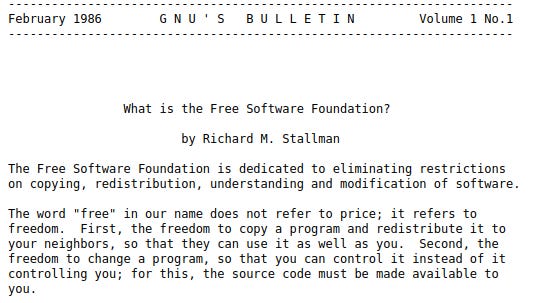
The open source movement began in earnest in the 1980s when developers questioned the notion that proprietary software should not be freely accessible for customization. In November of 1984, a software programmer named Richard Stallman made the first known public declaration that software should be free at the first Hackers Conference in Sausalito, California. The Free Software Foundation was founded in 1985 and the next year a definition of free software was published in the GNU’s Bulletin.1
Since then, many of the most powerful ideas and protocols have eventually been open sourced, or emerged directly from open source code, which not only enables universal access to these protocols, but enables democratized innovation and development.
Open source software forms the foundation for critical technology ecosystems including the Internet, operating systems, programming languages, databases, cloud infrastructure, cryptography, developer tools, and countless business and personal applications.
Critically, artificial intelligence, machine learning, and deep learning frameworks are also open source.
Open source is not merely a philosophical preference. It is a practical engine of technological acceleration. When the underlying tools are widely available, the number of people who can experiment, improve, adapt, and deploy those tools expands dramatically. Innovation moves from a small number of corporate labs into a much broader marketplace of developers, researchers, companies, and users.
Open Source AI
At the cutting edge of artificial intelligence stand both proprietary, closed models and open source large language models (LLMs). LLMs are advanced generative AI systems that leverage deep learning and data sets to create various forms of content including new text, images, code, audio, and video.
The consumer embodiment of these LLMs is represented by flagship companies that develop closed products like OpenAI’s ChatGPT, Anthropic’s Claude, or Google’s Gemini.
In contrast to these models, open source models promote transparency, accessibility, and rapid community-driven development that enables further innovation and customization.
The 2025 release of the LLM R1, developed by the Chinese research lab DeepSeek2, demonstrated that open source models could compete directly with proprietary models and be developed at a fraction of the cost, resources, and time.
That release challenged the assumption that frontier AI would remain permanently centralized inside a handful of large, closed, capital-intensive research labs. If open models can approach closed-model performance at much lower cost, then the structure of the AI market may begin to resemble prior software markets: an early phase dominated by closed products and centralized distribution, followed by a later phase in which open infrastructure becomes commercially unavoidable.
Comparability
The capability of LLMs can be measured by a test called the Massive Multitask Language Understanding benchmark3. The MMLU is made up of thousands of multiple-choice questions that assess the knowledge and reasoning capacity of different models across diverse domains including biology, economics, health, mathematics, philosophy, and more.
As recently as 2024, leading open models trailed 17.5 points behind the leading closed models. Today, they are near parity, with only a 0.3 gap in 2025 and with open models leading outright in an increasing number of evaluations.
And when evaluating for real-world academic or professional use-cases, open and closed models increasingly perform basically at parity, while open models outperform in the most critical dimension: cost.
This is the key market-structure change. Open source AI no longer has to win by being ideologically preferable. It can win by being good enough on performance and substantially better on cost, control, transparency, and customization.
Cost
Actually using AI in a business context is an increasingly expensive endeavor, due to the rising cost of models, driven by increasingly sophisticated systems that use larger and larger quantities of compute units (i.e. “tokens”) in their processes. And on top of that, as models are integrated into modern workflows, users and companies are demanding more and more from their models and increasing the number and intensity of their queries.
Managing cost is extremely relevant. A recent case from the news: in the month of May 2026, the transportation giant Uber announced that it had blown through its entire annual budget for AI usage in just the first four months of the year.4 The company encouraged employees to utilize AI as much as possible; an increasingly common directive within corporations of all stripes, but especially in the tech industry.
One key vector for increasing AI usage is the further integration of agents. AI agents are autonomous programs that perceive and analyze their environment, make decisions, and take actions, including advanced multi-step workflows, in pursuit of achieving goals set by their user.
A recent Goldman Sachs analysis projects that agentic AI will drive a 24x increase in token usage by 2030.5
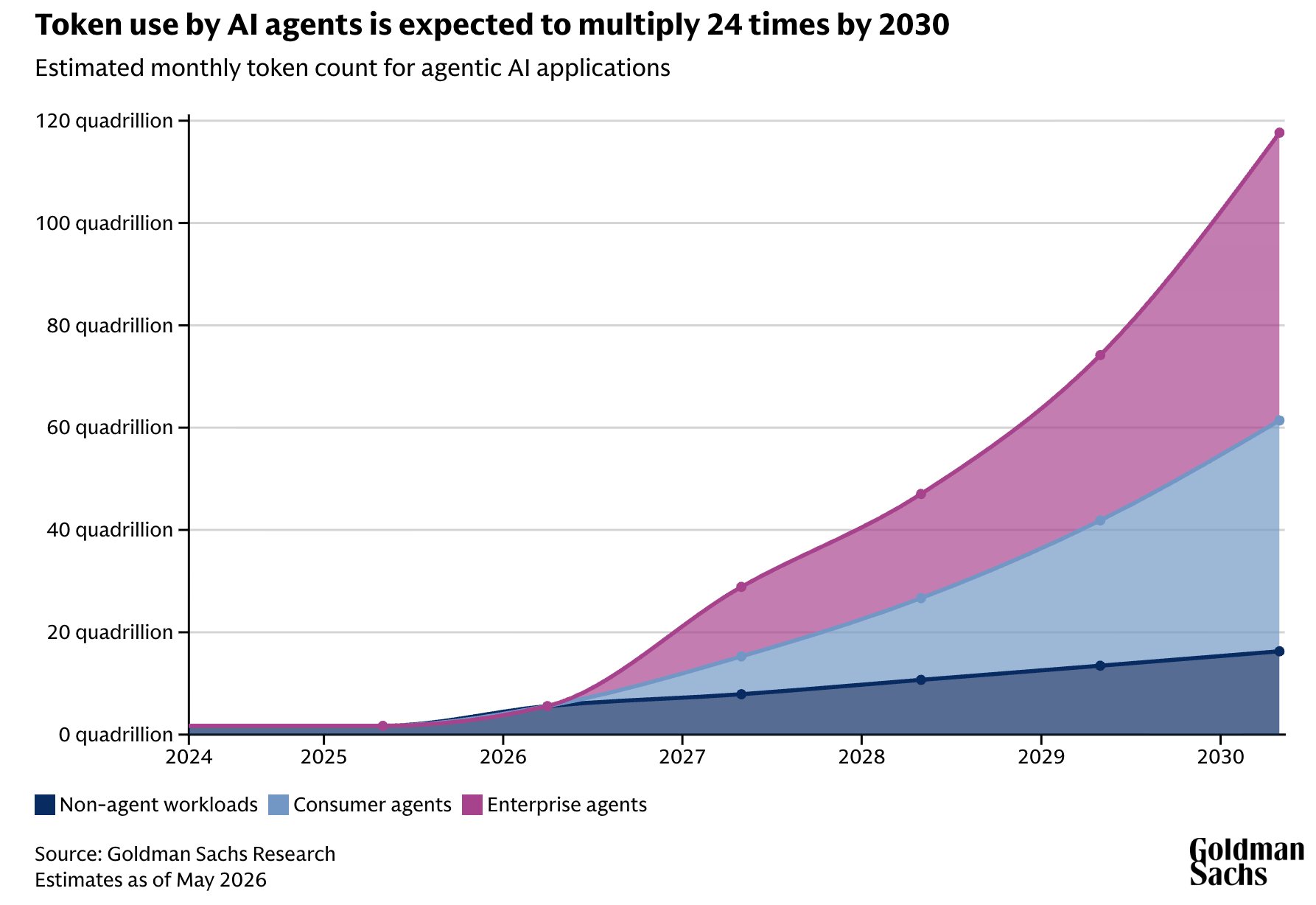
This exponential growth creates a staggering economic problem. If enterprises are already struggling to manage AI costs during the chatbot phase, then cost pressure becomes far more acute in the agent phase. A chatbot waits for a user prompt. An agent may run continuously, call multiple models, access multiple tools, retry failed steps, verify its own work, and execute multi-stage workflows. That means token usage can compound rapidly.
On a per-token basis, closed models are significantly more expensive to operate. A November 2025 paper from MIT researchers found that token spend was nearly 90% more expensive for proprietary models.6 “Nearly all open models price below $1.00 per million tokens, with many below $0.10, while closed models frequently exceed $10.00 per million tokens (such as Anthropic’s opus model or OpenAI’s gpt-4 model), reaching as high as $150.00 (OpenAI’s o1-pro model).”
The cost argument for open model supremacy is clear, but the vast majority of LLM queries are conducted via proprietary models. The reason is simple: it is still very complex for individuals or enterprises to access and integrate open models into their workflow. OpenAI, Anthropic, and Google are world-class research and development facilities. They are also brilliant consumer and business enterprises, and they make it easy to use their products.
The cost distinction also clarifies who is actually getting paid. In closed models, the customer is usually paying the model owner and operator for both the model IP and the “inference” (the process of running a trained AI model to generate an output from a user’s input). In open models, the model itself may be free to use, but production-quality usage is not free. The customer is usually paying for inference-as-a-service: GPU time, hosting, routing, reliability, latency, scaling, monitoring, and developer experience.
This means open source AI does not eliminate the market for AI infrastructure. It changes where value accrues. The economic center of gravity shifts away from owning the model itself and toward making the model usable at scale.
Open models may be cheaper. They may be transparent. They may be customizable. They may even be comparable in performance. But enterprises do not buy theoretical advantages. They buy products that work, integrate, scale, and can be trusted.
The Regulatory and Enterprise Unlock
Regulatory frameworks to effectively oversee artificial intelligence implementation have been hot topics of policy discussion for the better part of a decade, with most attempts in the U.S. falling flat. The European Union’s AI Act passed in the spring of 2024 and is coming into effect in real time. Among other things, the AI Act requires models to be more auditable, with verifiable data paths, documentation obligations, transparency standards, and safeguards against unsafe or opaque deployment. Wide-spread integration of open source AI models is a natural next step.
As AI moves from experimentation into production, enterprises and regulators will increasingly care about auditability, explainability, data control, security, reliability, and accountability. Closed models can satisfy some of these needs, but they require companies to depend heavily on external vendors whose model weights, training processes, inference systems, and operating decisions are often not fully visible.
Open source AI offers a different path. It gives enterprises more control over what they deploy, how they deploy it, where data flows, and how models are monitored and adapted. In regulated industries, that control can become a strategic advantage.
The result is not a single regulatory unlock like a license or rule change. It is a broader market-structure unlock: as enterprises become more serious about AI deployment, the demand for controllable, auditable, lower-cost, enterprise-ready AI infrastructure should increase.
Easier Said than Done
But integrating open source models into existing workflows is far from a trivial problem. It requires substantial engineering time and resources including setting up inference infrastructure, selecting and benchmarking models, developing monitoring systems to assess performance and alert issues, and optimizing throughput and latency.
Quality assurance, reliability and uptime, security, and compliance responsibility also shift in-house. The implementing entity becomes responsible for patching vulnerabilities, managing model drift, handling access controls, protecting sensitive data, and hewing closely to any relevant regulations.
For startups, this is difficult. For enterprises, it can be totally prohibitive.
The irony is that the very characteristics that make open source AI attractive — transparency, flexibility, customization, and control — also create substantial operational complexity. A company may want the cost and sovereignty benefits of open models, but not want to assemble and maintain a full AI infrastructure stack internally.
This creates the opportunity for an integrated commercialization layer.
Enter BasedAI
BasedAI is building the commercialization layer for open source AI. Its ambition is to do for open source AI what Red Hat did for Linux: take powerful but fragmented open infrastructure and make it usable, reliable, supported, and commercially viable for enterprises.
Open source models are excellent; the problem is that enterprises cannot easily use them. A company that wants the cost, control, and transparency benefits of open source AI still has to manage inference infrastructure, model selection, monitoring, latency, uptime, security, compliance, and workflow integration. For most companies, that is an enormous burden.
BasedAI is designed to remove that burden.
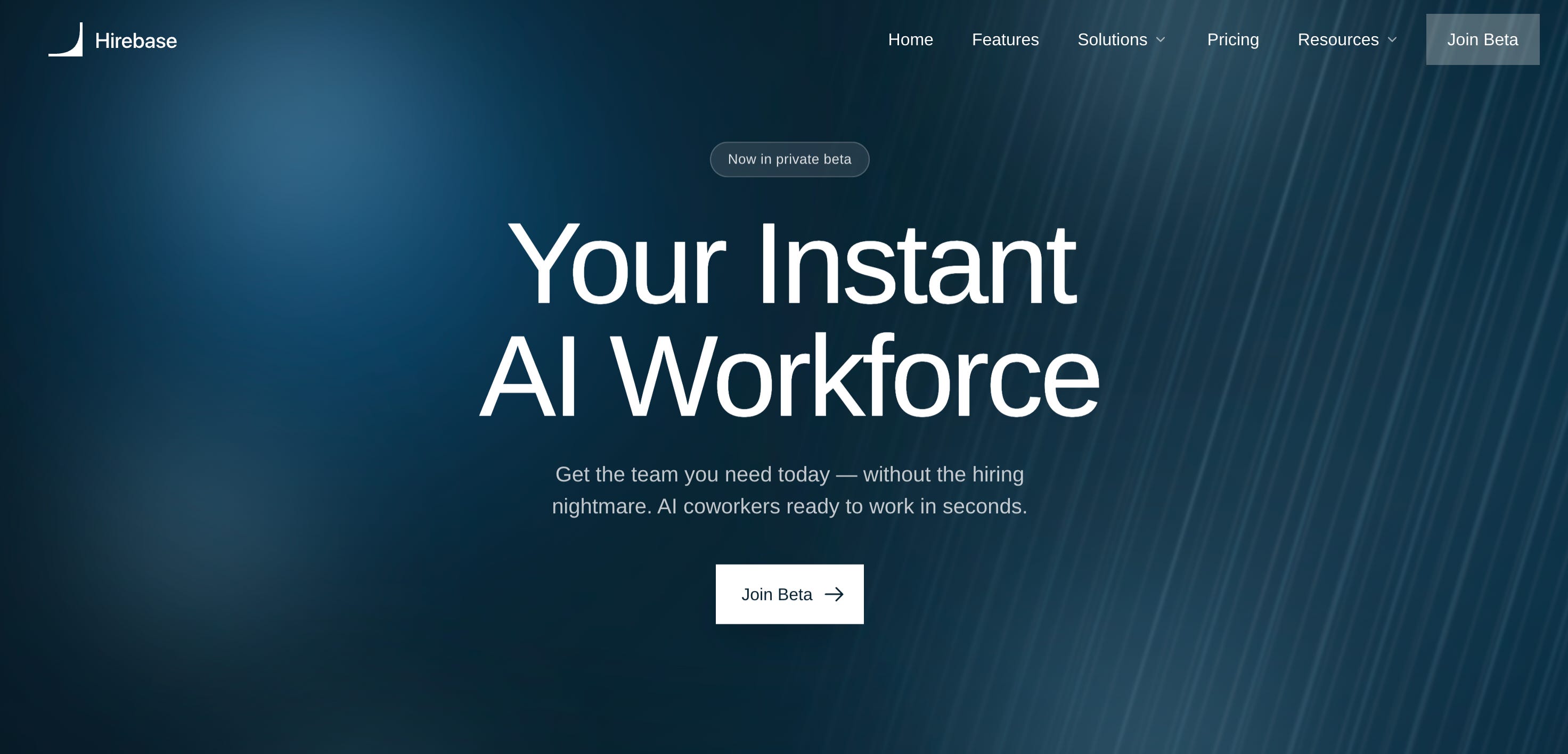
The company’s platform has two initial products. The first is Hirebase, which gives companies AI employees for business functions like sales, support, operations, finance, HR, and marketing. The second is Based APIs, which gives enterprises a single access point for open-weight model inference. Together, the two products reflect the core insight of the company: open source AI needs both infrastructure and applications. Enterprises need access to capable models, but they also need those models embedded into workflows that actually produce business outcomes.
BasedAI is also pursuing a roll-up strategy, acquiring and consolidating fragmented open source AI projects under one roof. This matters because open source ecosystems are often technically rich but commercially scattered. Individual projects can have strong code, useful communities, or specialized capabilities, but lack enterprise distribution, support, compliance, and long-term monetization. BasedAI’s thesis is that aggregation can turn that fragmentation into a platform advantage.
The acquisition of Warden is an example of this strategy, and hints at the converging paths of artificial intelligence and crypto. Warden adds multi-agent orchestration capability, which strengthens BasedAI’s ability to support agentic workflows rather than merely provide model access.
The deeply and broadly experienced BasedAI team is a core part of the LVC investment thesis because the company is not pursuing a narrow software product; it is attempting to commercialize open source AI across enterprise infrastructure, agentic workflows, acquisitions, and eventually public-market access. That requires a rare combination of AI judgment, frontier tech fluency, enterprise credibility, capital markets awareness, and regulatory sensitivity.
CEO Teana Baker-Taylor brings institutional and executive operating experience across crypto, financial services, and global technology markets, with prior roles at Venice AI, Circle, Binance, Crypto.com, Citi, and HSBC. COO Josh Goodbody adds deep digital-asset operating experience and agent-orchestration relevance through Warden and prior senior roles across crypto and traditional finance. David A. Johnston strengthens the open-source, decentralized systems, and agentic AI side of the company, with a long history in decentralized applications and crypto-native coordination systems. BasedAI has to earn enterprise trust, integrate open-source projects, navigate regulatory and market-structure uncertainty, and understand how AI agents may eventually interact with crypto-native payment, identity, and settlement rails. The team is well-matched to that complexity.
LVC x BasedAI
Open source AI is becoming more capable. Enterprise AI costs are rising. Regulation is pushing the market toward transparency and accountability. Agents are increasing the intensity of AI usage. And as agents speed up the rate at which they transact, coordinate, and execute tasks across software environments, they will need rails for payment, permissioning, identity, and settlement.
BasedAI sits at the intersection of multiple trends: open source AI commercialization, enterprise inference, agentic workflows, and the growth of agentic commerce.
Every major software shift eventually produces infrastructure companies that make the new capability usable for institutions. Open source software produced Red Hat. Cloud computing produced AWS, Azure, and Google Cloud. Crypto produced exchanges, custody platforms, stablecoin issuers, and compliance tooling. Open source Artificial Intelligence will require its own enterprise infrastructure layer to enable rapid uptake and innovation.
BasedAI is that layer, and LVC is proud to partner with them for the next step.
The Hirebase platform is currently in Private Beta
Frank Nagle & Daniel Yue, The Latent Role of Open Models in the AI Economy 1 (Nov. 18, 2025), https://ssrn.com/abstract=5767103; see also http://dx.doi.org/10.2139/ssrn.5767103